

Advise (the default)
ChangeGuard proposes fixes and waits for a human to approve each one. An approval authorizes exactly that change, once. When an incident is detected, ChangeGuard AI proposes a fix — the exact patch, with the reasoning — and it appears in Remediations as Awaiting approval with Approve and Reject. Approving requires an operator, admin or owner; an API key cannot approve. The approval binds the exact action, ChangeGuard issues a Permit, the Executor applies the patch, and ChangeGuard verifies recovery against fresh evidence. The record then reads Verified, with its ladder — Permit issued → Execution started → Action applied → Verifying → Verified — and proposed by changeguard-agent · approved by ‹your email›. Rejecting keeps the record too, with the reason.Auto (opt-in)
ChangeGuard AI may authorize its own proposal — but only inside an explicit execution policy for this environment, and never outside it. The policy sits beside the Mode toggle:
The product refuses to act on an incomplete policy: Nothing auto-executes — Auto requires a complete policy (namespaces, fix types, confidence floor, hourly cap). A fix authorized under Auto records approved by agent-policy together with the policy id and version, and still becomes a single-use Permit consumed by the Executor. Anything outside the policy waits for a person, exactly as in Advise. Editing the policy bumps its version and revokes any Permit issued under the old one.
Either way
- Every applied fix is verified against fresh evidence before it is called successful; a fix that fails verification is handed to a human, and a compensating action needs its own authority and its own Permit.
- Every record keeps mode at execution, approver or policy version, and the Permit, permanently.
- The watching side stays read-only; only the Executor you enabled can write, only where you scoped it, only with a Permit.
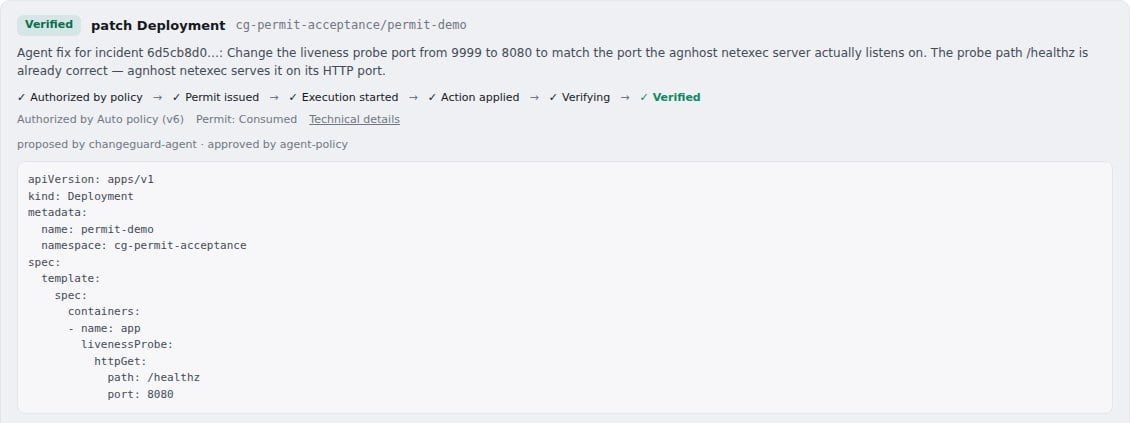
A verified fix authorized by policy under Auto: the ladder from authorized through Permit issued, execution started, action applied and verifying to VERIFIED — Permit consumed once, policy version recorded.