

Missing evidence is never safe
A verdict is only as good as what it could see, so every judgment lists its evidence classes and their status. A proposed artifact that has not been independently evaluated is HOLD, never SHIP — ChangeGuard AI will not say “ship” on evidence it does not have. When an environment has not reported recently, the judgment says so and is made on the change alone. The Evidence card’s header — absent evidence is never counted as safe — is the rule, and the record keeps the evidence list forever.The reasons are in plain terms
A BLOCK says what would break and by how much. From a real pull request against a live environment: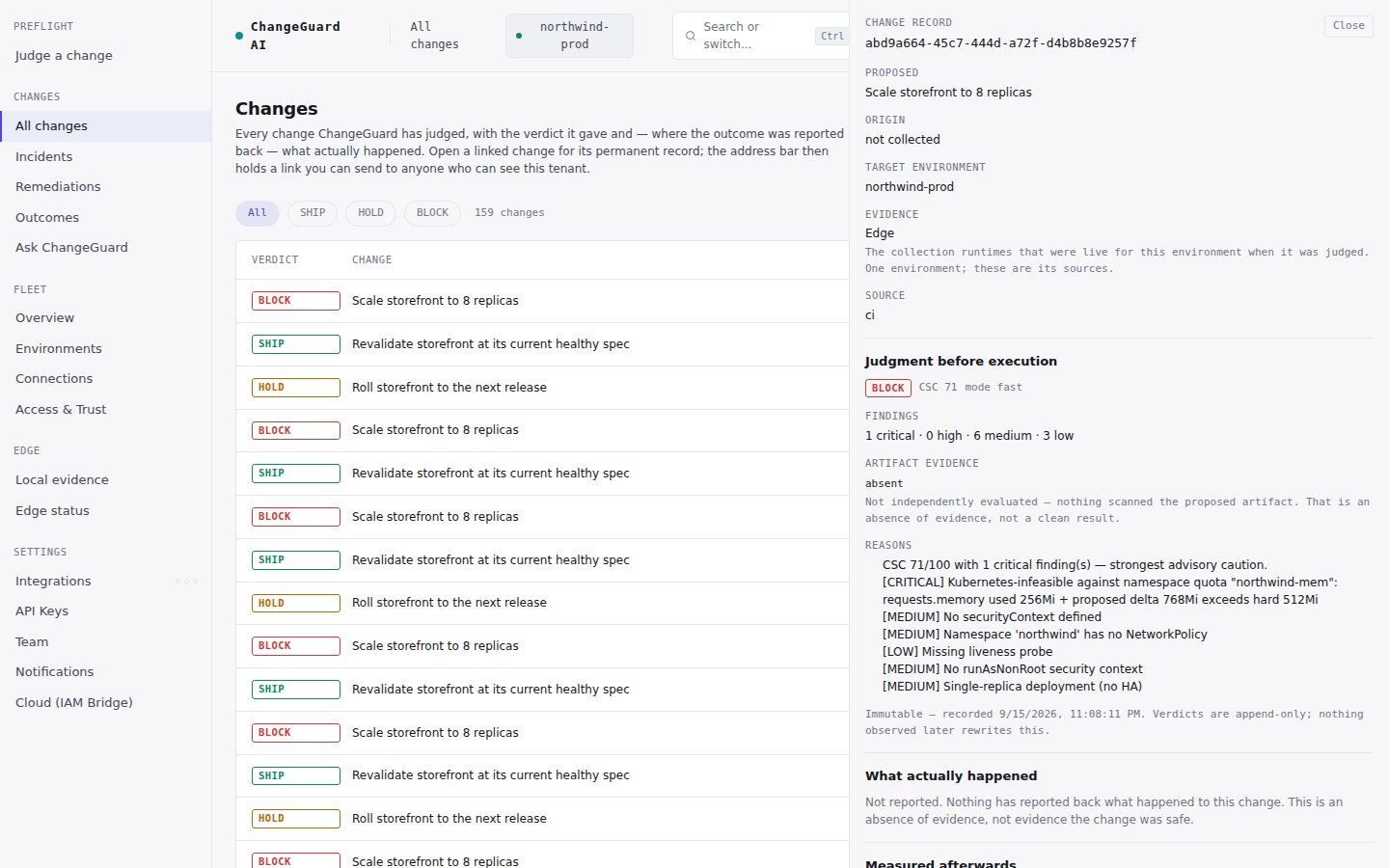
[CRITICAL] Kubernetes-infeasible against namespace quota: requests.memory used 256Mi + proposed delta 768Mi exceeds hard 512Mi. Valid manifest; wrong in context.
The CSC score
When live environment evidence is present, the judgment also shows a CSC number from 0 to 100 — the Change Safety Confidence score, a deterministic readiness measure of the environment the change is entering. You do not need it to read a verdict; it is there for trend and comparison, and it is explained in Understanding your score.Advisory by default, enforceable where you choose
ChangeGuard AI states a verdict; it does not deploy and does not prevent a deploy by itself. In GitHub, a BLOCK fails the pull-request check and a HOLD never does — whether a failed check stops a merge is your branch rule. The Action can be set to purely advisory withenforce_block: false; the verdict is recorded either way. Other pipelines read the verdict and decide for themselves (Use the verdict in CI).
Next: 4. Connect an environment.